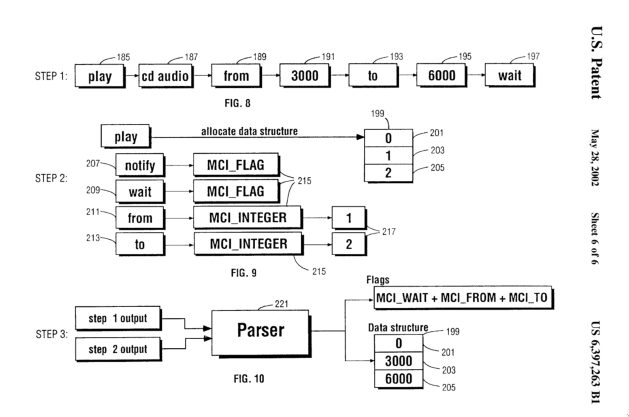
MCI (Media Control Interface) is an old Windows API for controlling media devices with high-level command strings like play file.wav from 0 to 100. The general shape is:
command <device> [parameters ...]
There is no fixed list of commands. Instead, a command table defines each command and its arguments, and the parser reads it, so new commands can be added by just editing the table. Here’s part of the open entry in ScummVM’s in-memory command table:
static CmdTableRow table[] = {
  {"open"            ,MCI_OPEN      ,0          ,MCI_COMMAND_HEAD },
  {""                ,MCI_INTEGER   ,0          ,MCI_RETURN }      ,
  {"notify"          ,0x00000001L   ,-1         ,MCI_FLAG }        ,
  {"wait"            ,0x00000002L   ,-1         ,MCI_FLAG }        ,
  {"type"            ,0x00002000L   ,-1         ,MCI_STRING }      ,
  {"element"         ,0x00000200L   ,-1         ,MCI_STRING }      ,
  {"alias"           ,0x00000400L   ,-1         ,MCI_STRING }      ,
  {"shareable"       ,0x00000100L   ,-1         ,MCI_FLAG }        ,
  {""                ,0x00000000L   ,-1         ,MCI_END_COMMAND } ,
  // ...
IBM patented this parsing mechanism. The patent goes as far as specifying that tokens are kept in a linked list rather than an array, probably for low-memory devices, and that the parsed arguments end up in a byte array at fixed offsets.
Wine’s MCI parser does the same thing: it parses the command strings a Win32 program sends and translates them into calls to Linux sound and video APIs. ScummVM does the same with its own APIs, but stores each command’s arguments in a hash table instead of a byte array.